
The Foundation of Goju-Ryu: Three Battles in One Form
Translated from Japanese, Sanchin means “Three Battles” or “Three Conflicts.” Rather than fighting an external opponent, this kata represents the internal battle to unify mind, body and breath.
- Mind: Developing calm, undivided focus that doesn’t give in to panic under stress.
- Body: Connecting the skeletal frame from the feet, through the legs and into the spine in a connected, rooted chain.
- Breath: Using deep, diaphragmatic breathing to shield vital organs.
In authentic Goju-Ryu karate, true power always begins from the ground up. Therefore, our system uses Sanchin as an essential diagnostic tool and physical powerhouse.
Goju-Ryu begins with Sanchin and ends with Sanchin. In fact, every fundamental block, strike, and transition across advanced katas draws its structural power directly from the principles forged within this single form.
1. Sanchin-Dachi: The Biomechanics of Rooted Stability
At the very core of the form lies Sanchin-dachi. To build this stance, you place your feet shoulder-width apart, align the front heel with the rear toe, turn the toes slightly inward, and drive the knees outward and down to grip the floor.
This internal tension directly engages the hip adductor muscles along the inner thighs. Beyond simply drawing the legs toward your midline, these adductors play an essential role in stabilizing your pelvis, supporting balance, and rooting your lower torso into the earth. When these muscles work in harmony with your pelvic floor and lower abdomen, they create a strong, unbroken kinetic chain.
Instead of generating force solely from the shoulders or arms, this engaged muscular chain transfers ground-reaction force directly upward through the hips and out through the limbs. As a result, the body transfers martial power smoothly and efficiently.
The Sanchin Kinetic Chain: Target Muscle Groups
During Sanchin, practitioners engage nearly every major muscle group in continuous, dynamic isometric tension:
1. Lower Body (The Root)
- Adductor Group: Grips the midline and firmly stabilizes the pelvis.
- Gluteus Muscles: Tucks the hips to lock the lower tanden.
- Quadriceps & Calves: Anchors the foot arches into the floor.
2. Core (Pneumatic Shield)
- Transverse Abdominis: Builds intra-abdominal pressure during ibuki.
- Rectus & Obliques: Forms a dense, protective muscular shield over organs.
- Pelvic Floor: Uplifts and secures lower abdominal pressure.
3. Upper Frame (Structure)
- Latissimus Dorsi: Lowers the shoulders and connects the arms to the spine.
- Pectoralis Muscles: Braces the rib cage to safeguard the chest cavity.
- Forearm Flexors: Maintains a rigid wrist and fist alignment.
True strength in Goju-Ryu is not about tensing individual muscles. It is the ability to connect the entire skeletal frame into a single, unbreakable structure through the floor.
2. Ibuki Breathing: Dynamic Tension and Internal Pressure
Movement without breath remains hollow. Therefore, Sanchin Kata utilizes ibuki—a method of deep diaphragmatic breathing synchronized with isometric muscular contraction. First, you inhale deeply, compressing the breath with your diaphragm and abdominal wall, which locks air down into the abdomen against contracted core muscles. In doing so, you turn your torso into a dense, shock-absorbing container. Next, you exhale slowly with audible pressure while engaging your core, lats, and pelvic floor to stabilize the spine and rib cage.
This internal pneumatic pressure effectively shields your vital organs. For instance, your liver, spleen, kidneys, and stomach lack the bony protection that encases your heart and lungs. By actively engaging your abdominal wall, you form a hydraulic cushion. If an opponent lands a strike, your pressurized torso immediately disperses that force rather than transferring it directly into vulnerable organs. In addition, this pressurized cylinder stabilizes the lumbar spine, protecting against compression injuries by absorbing impact.
Furthermore, this breathwork systematically conditions the nervous system to remain calm under physical stress. When an untrained person faces sudden conflict, their body automatically activates the fight-or-flight response. Adrenaline spikes, producing a racing heart, shallow chest breathing, and tunnel vision. However, in our adult karate programs, mastering this breathing pattern teaches students how to maintain mental clarity while managing physical fatigue and impact. Deep diaphragmatic breathing stimulates the vagus nerve, which directly governs the parasympathetic nervous system. Consequently, the pressurized breath pattern reassures the brain that the body is in control, dampening adrenaline surges and helping you stay deliberate under pressure.
3. Sanchin Shime: HOW INSTRUCTORS TEST DYNAMIC TENSION
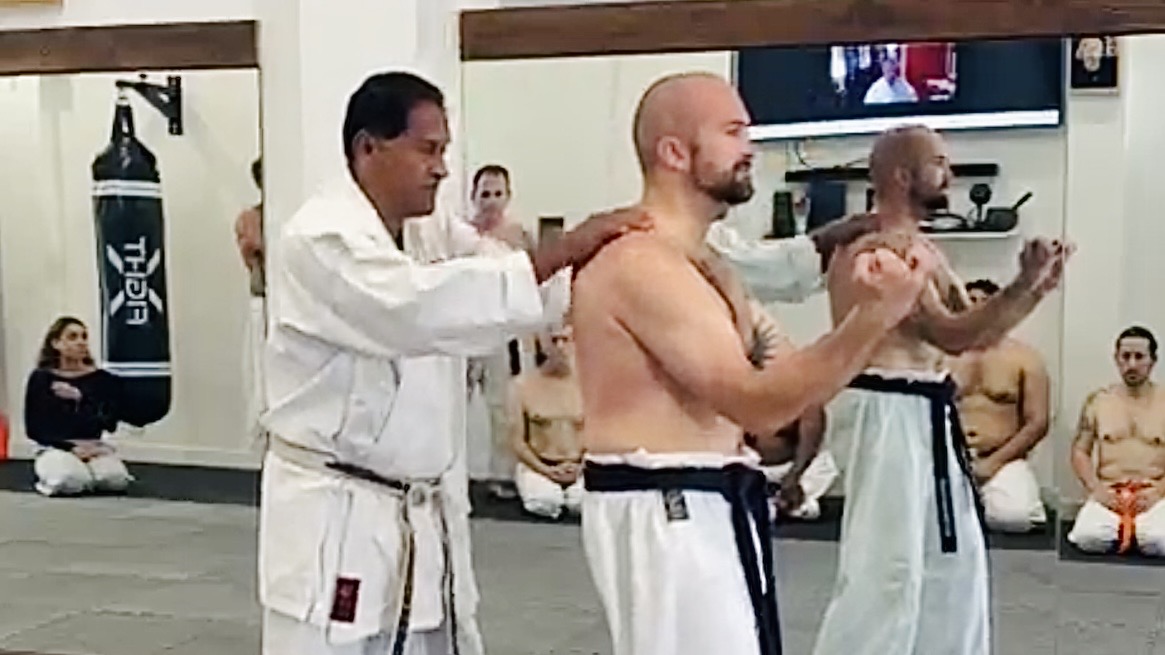
A student cannot simply assume their stance is strong; they must verify it. In traditional dojos, senior instructors perform shime—a rigorous biomechanical audit during Sanchin Kata. Through deliberate slaps, pushes, and checks to the legs, lats, shoulders, and core, the instructor immediately exposes any weak link in the kinetic chain or breath timing. If a student misaligns a joint or holds their breath incorrectly, an instructor’s check will instantly reveal the imbalance. Instructors always calibrate this testing with great care, prioritizing both safety and student rank.
The Diagnostic Checklist: What Instructors Look For
During shime, the instructor focuses on three primary checkpoints:
- Sanchin-Dachi: The student must remain anchored through the feet and adductor muscles into the pelvis.
- Ibuki: The pneumatic breath pressure must actively protect the internal organs and brace the spine.
- Kime: The shoulders, lats, and chest must lock together as a unified protective shield.
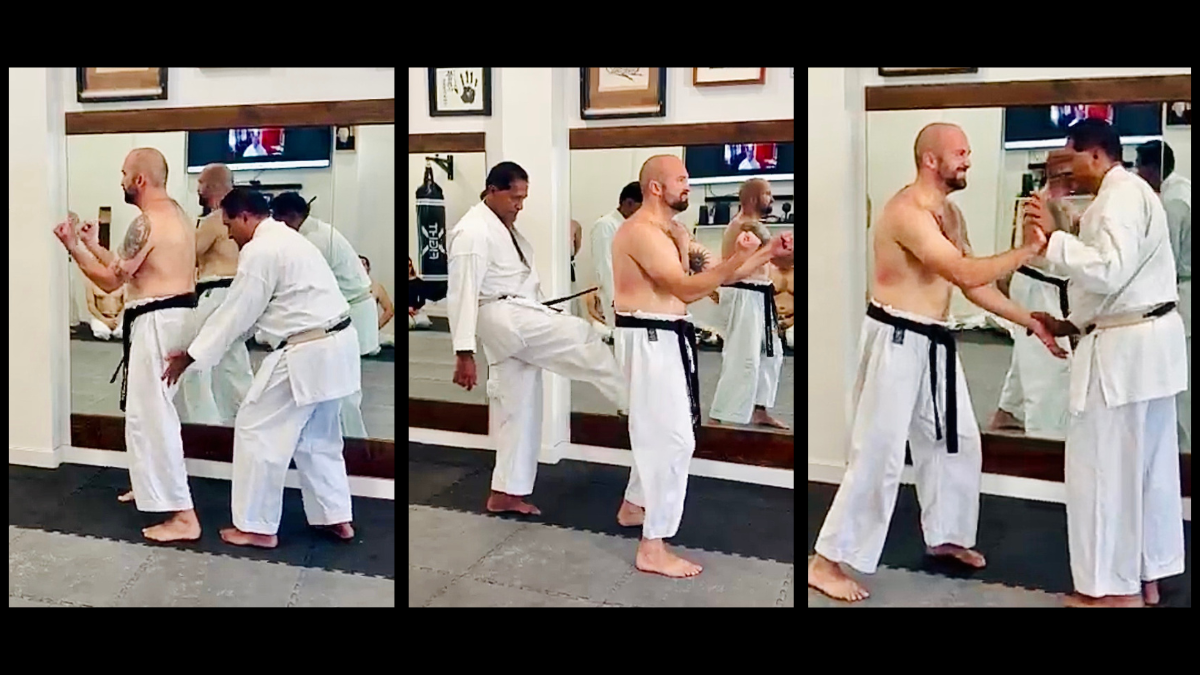

Furthermore, instructors deliver tactile checks methodically, striking exclusively on the student’s exhalation when isometric tension reaches its peak:
- Thighs and Inner Legs: Tests whether the stance stays firm with correct outward knee drive.
- Hips and Buttocks: Checks whether the practitioner tucks the hips upward to prevent excessive lower back arching.
- Latissimus Dorsi and Flanks: Ensures the back muscles engage properly to stabilize the torso.
- Core and Abdomen: Verifies that the student has locked their breath and braced their abdominal wall.
- Shoulders and Traps: Confirms the student keeps the neck relaxed without hiking the shoulders.
- Balance and Center of Gravity: Checks whether the practitioner can absorb a direct push without yielding ground.
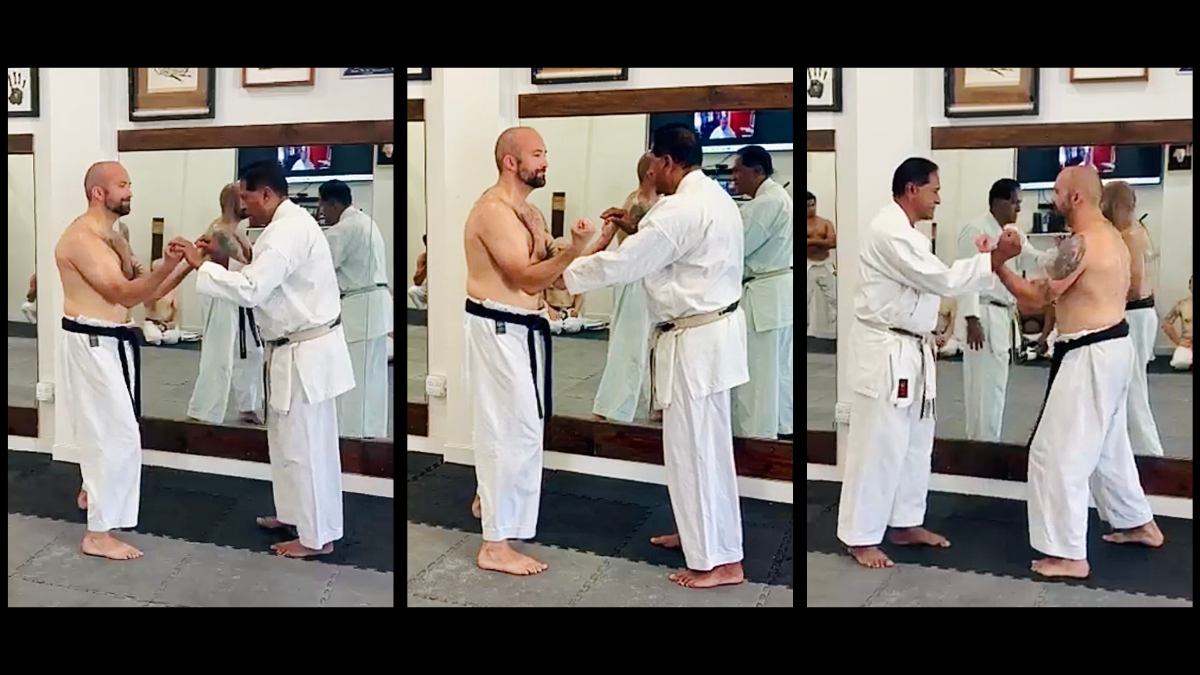
Under the leadership of Shihan Vassie Naidoo and our senior instruction team, this classical method builds quiet composure, physical resilience, and complete awareness. Ultimately, true composure is an internal choice: staying calm, centered, and focused during high-pressure moments both on the mat and in daily life.
Experience Authentic Goju-Ryu in West LA
Whether you are seeking functional core conditioning, authentic lineage kata training, or stress-relieving martial arts discipline, our adult program welcomes practitioners of all experience levels.
Leave A Comment